
The look people call billionaire is not actually how billionaires photograph. It is a specific editorial style built on restraint: real materials, one honest light source, and almost no visible logos. Most AI attempts at it fail because they add more, when the entire aesthetic is built on subtraction. Below are four full prompts and the tells that give a fake one away.
Summary
- Wealth reads through materials and light, not through objects. Cashmere, linen, patina and a single window source do more than a supercar.
- Logos destroy the effect. The quiet luxury reference brands are recognisable by cut and fabric, not by branding, and AI renders logos as garbled nonsense anyway.
- Do not pose with the expensive thing. Sit near it, ignore it, do something ordinary. Proximity reads as ownership, contact reads as a rental.
- Detail shots outperform wide flex shots. A wrist, a cuff, a cup on stone is more convincing than a full-body frame in front of a jet.
- Ordinary actions sell it. Reading, drinking coffee, looking out of a window. Arms spread on a car bonnet does not.
- The line that matters: aspirational brand imagery is fine, fabricated proof of results is not.

Table of Contents
- What people actually mean by the billionaire look
- Why most luxury AI photos read as fake
- What genuinely signals wealth in a photograph
- Prompt 1: the quiet luxury terrace
- Prompt 2: private aviation
- Prompt 3: the watch detail
- Prompt 4: the car, shot properly
- Wardrobe rules for luxury frames
- The credibility line you should not cross
- Common mistakes
- Frequently asked questions
What Do People Actually Mean by the Billionaire Look?
They mean quiet luxury editorial photography, which is a real and specific genre. It is the visual language of Loro Piana and Brunello Cucinelli campaigns, of travel magazines and old-money portraiture. It is not the visual language of actual billionaires, most of whom photograph badly in fleece vests at conferences.
That distinction matters because it tells you what to imitate. You are not imitating wealth. You are imitating a photographic style that has been used to sell wealth for forty years, and that style has consistent rules: neutral palettes, natural fibres, natural light, unposed subjects, negative space, and a near total absence of visible branding.
Why Do Most Luxury AI Photos Read as Fake?
Because they treat luxury as a shopping list. The prompt names a jet, a Rolex, a Lamborghini and a penthouse, and the model dutifully renders all four at once, which is something no real photograph contains. Five tells repeat.
- Too many signifiers in one frame. Real photographs have one subject. A jet, a watch, a car and a city skyline in the same image is a collage, not a photograph.
- Garbled logos. Models cannot render brand marks. Every attempted logo comes out as melted lettering, and it is the single fastest way to be identified as generated.
- Contact with the expensive object. Leaning on the car, hand on the jet stairs, arms spread across the bonnet. This is rental-photo body language and everyone recognises it.
- Even, sourceless light. Luxury interiors are lit by windows and practical lamps with real falloff. A penthouse lit evenly from all sides is a render.
- Posed eye contact. The genre is candid and observational. A subject looking down the lens with a slight smirk reads as advertising, and cheap advertising at that.
If you have not read the underlying method yet, our guide to making AI photos of yourself that do not look AI covers the trained-model workflow and the six-block prompt structure this piece builds on.
What Genuinely Signals Wealth in a Photograph?
Five things, none of which are the price of the object in frame.
| Signal | How it appears in a photo | How to prompt it |
|---|---|---|
| Material quality | How fabric drapes, wrinkles and catches light | Name the fibre and its behaviour: linen that wrinkles, cashmere with visible knit |
| Access | Being somewhere most people cannot be, casually | Private, empty or closed spaces at odd hours |
| Restraint | Very few objects, lots of negative space | Name three props maximum, and no logos |
| Patina | Worn stone, aged leather, creased sneakers | Ask for age and wear explicitly |
| Indifference | Subject ignoring the expensive thing | Give them an ordinary action facing away from it |
Indifference is the one people find hardest to accept. The moment the subject acknowledges the expensive object, the photograph becomes about the object, and photographs about objects read as advertising. When the subject ignores it, the object becomes context, and context reads as ownership.
Prompt 1: The Quiet Luxury Terrace
This is the purest version of the aesthetic and the best one to start with, because it contains almost nothing. Stone, linen, coffee, sea. If you can make this frame convincing you can make any of the others convincing.
A genuine professional photograph of Cody Wise, not an illustration or render. A stone terrace of a Mediterranean villa in the hour after sunrise, weathered limestone underfoot, an old olive tree to one side, the sea a flat pale band far below and out of focus. He stands at the low stone wall, forearms resting on it, holding a small ceramic coffee cup in one hand with correct finger placement, looking out at the water. A linen napkin and a folded newspaper sit on the wall beside him. Wardrobe: quiet luxury, an unbuttoned white linen shirt with sleeves rolled to the forearm, wrinkling exactly as linen does, ivory linen trousers, bare feet, a simple leather-strap watch, no logos and no jewellery beyond the watch. Lighting: low warm morning sun from camera-right and slightly behind, raking across the stone texture and putting a warm rim along his forearm and jaw, with cool open shade filling the front of his body from the sky. Long soft shadows run across the terrace toward camera-left. Camera: photographer standing about five metres away at chest height, 35mm lens at f/4, full frame. Subject and stone wall sharp, the olive tree softening, the sea and horizon genuinely soft from distance and haze. Restrained natural grading, white linen reads white, no teal and orange, the sky allowed to run bright. Skin shows real pores, texture and slight asymmetry, no smoothing or beauty retouching. Candid documentary moment, not looking at camera. No readable text anywhere. No CGI look, no plastic skin, no fake film filter.
What is doing the work
Bare feet. It is the cheapest detail in the prompt and it carries more than the villa does, because bare feet mean he lives here rather than visiting. Add one detail per frame that implies residence rather than access, and the whole image settles.
Prompt 2: Private Aviation
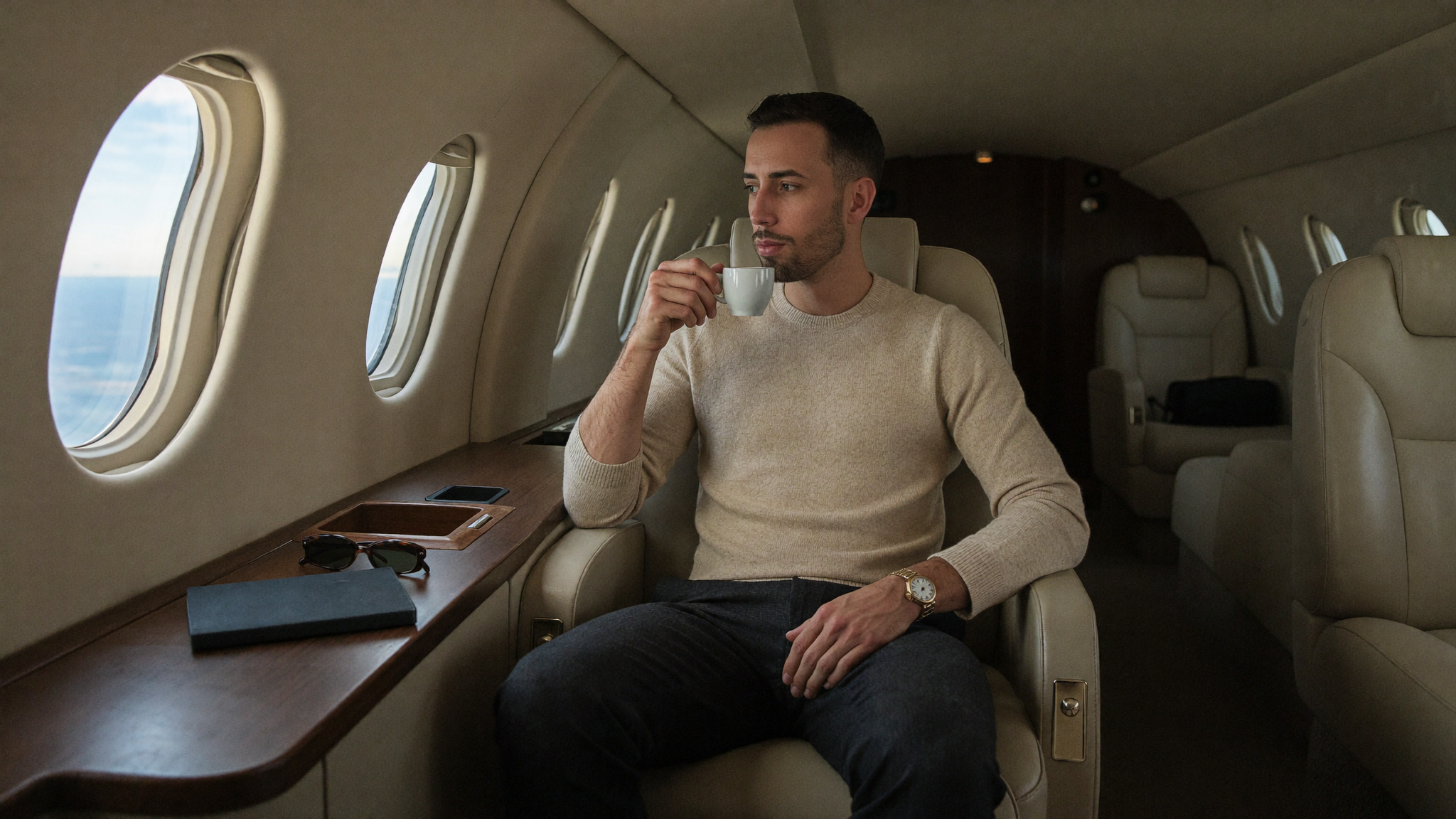
The most abused scene in this entire category, and it is abused because people shoot it from outside on the airstairs. Shoot it from inside, seated, in flat morning light, with the subject looking out of the window. The cabin becomes a small room with one light source, which is a photographic problem you can actually solve.
A genuine professional photograph of Cody Wise, not an illustration or render. Interior of a small private jet cabin on the ground in early morning, cream leather club seats and a polished wood side table. He sits angled toward the oval window, one forearm on the armrest, the other hand holding a small espresso cup correctly by the handle with natural finger anatomy. A closed notebook and a pair of sunglasses sit on the table. Wardrobe: quiet luxury, an oatmeal cashmere crewneck with visible knit texture and natural drape, charcoal tailored trousers, a slim gold-toned dress watch sitting correctly on the wrist, no visible logos anywhere. Lighting: single source, cool overcast daylight through the oval cabin window camera-left, falling across his face and the leather, with the depth of the cabin behind him falling into soft shadow and only a faint warm spill from the cabin footwell lights. Camera: photographer seated in the opposite club seat roughly two metres away at seated eye level, 35mm lens at f/2.8, full frame. Subject sharp, the far end of the cabin softly out of focus, the window highlight allowed to blow out as a real camera would. Restrained natural colour grading, believable dynamic range, cream leather reads cream and not yellow. Skin shows real pores, texture and slight asymmetry, no smoothing or beauty retouching. Candid documentary moment, looking out of the window, not at the camera. No readable text or lettering anywhere in the cabin. No CGI look, no plastic skin, no fake film filter.
On the ground, not in the air
Specifying that the aircraft is on the ground in early morning gives the model a coherent lighting situation: flat ambient daylight through one window. In-flight scenes tend to produce impossible light, because the model has to invent what is outside and usually invents a sunset that contradicts the cabin lighting.
Prompt 3: The Watch Detail
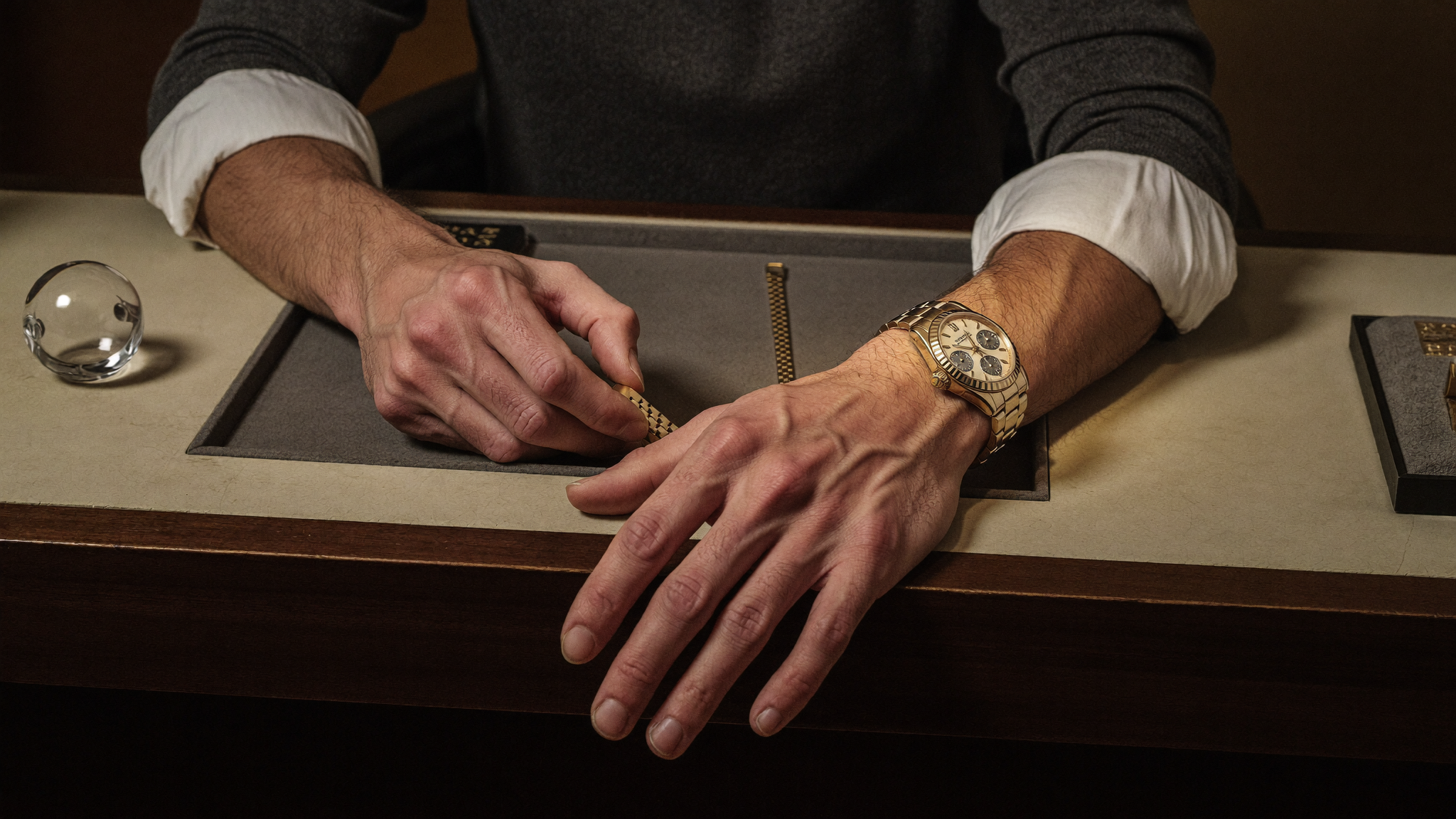
Detail shots are the most underused frame in this genre and the most convincing. There is no face to get wrong, no full-body proportion to check, and the entire image is texture: skin, metal, cotton, wood. It is also the frame most likely to survive scrutiny, provided you guard the dial.
A genuine professional photograph, not an illustration or render. A tight detail photograph of a man's hands and left wrist as he adjusts the bracelet of a gold and steel luxury wristwatch, seated at a dark walnut counter in a private watch salon. Correct hand anatomy with five fingers on each hand, natural knuckle and tendon detail, realistic fingernails, the watch bracelet physically connecting to the case and sitting correctly on the wrist with believable weight. A soft grey suede watch tray and a loupe rest on the counter. Only the hands, wrist, forearms and lower chest are in frame, the face is out of frame above. Wardrobe: white shirt cuff turned back, showing real cotton weave and a pressed fold, a plain charcoal knit sleeve above it. Lighting: warm directional retail spotlight from above and camera-right creating a hard specular highlight along the polished bracelet links and the crystal, with soft fill bouncing off the pale counter surface and the shadow side of the hands left genuinely dark. Camera: photographer standing close, roughly one metre away, looking down at a shallow angle, 100mm macro lens at f/4, full frame. Watch and near hand sharp, the tray and counter fall off quickly. Restrained natural grading, gold reads as warm metal and not orange. Skin on the hands shows pores, fine hair, knuckle creases and natural imperfection, no smoothing. No readable text, numerals or lettering on the watch dial, no brand names anywhere. No CGI look, no plastic skin, no fake film filter.
Guard the dial, always
Watch dials attract invented lettering more aggressively than almost any other surface, because the model knows dials usually have text on them. Explicitly forbid text, numerals and brand names on the dial. Accept that you will discard more frames here than anywhere else, and check the bracelet actually connects to the case before you publish.
Prompt 4: The Car, Shot Properly
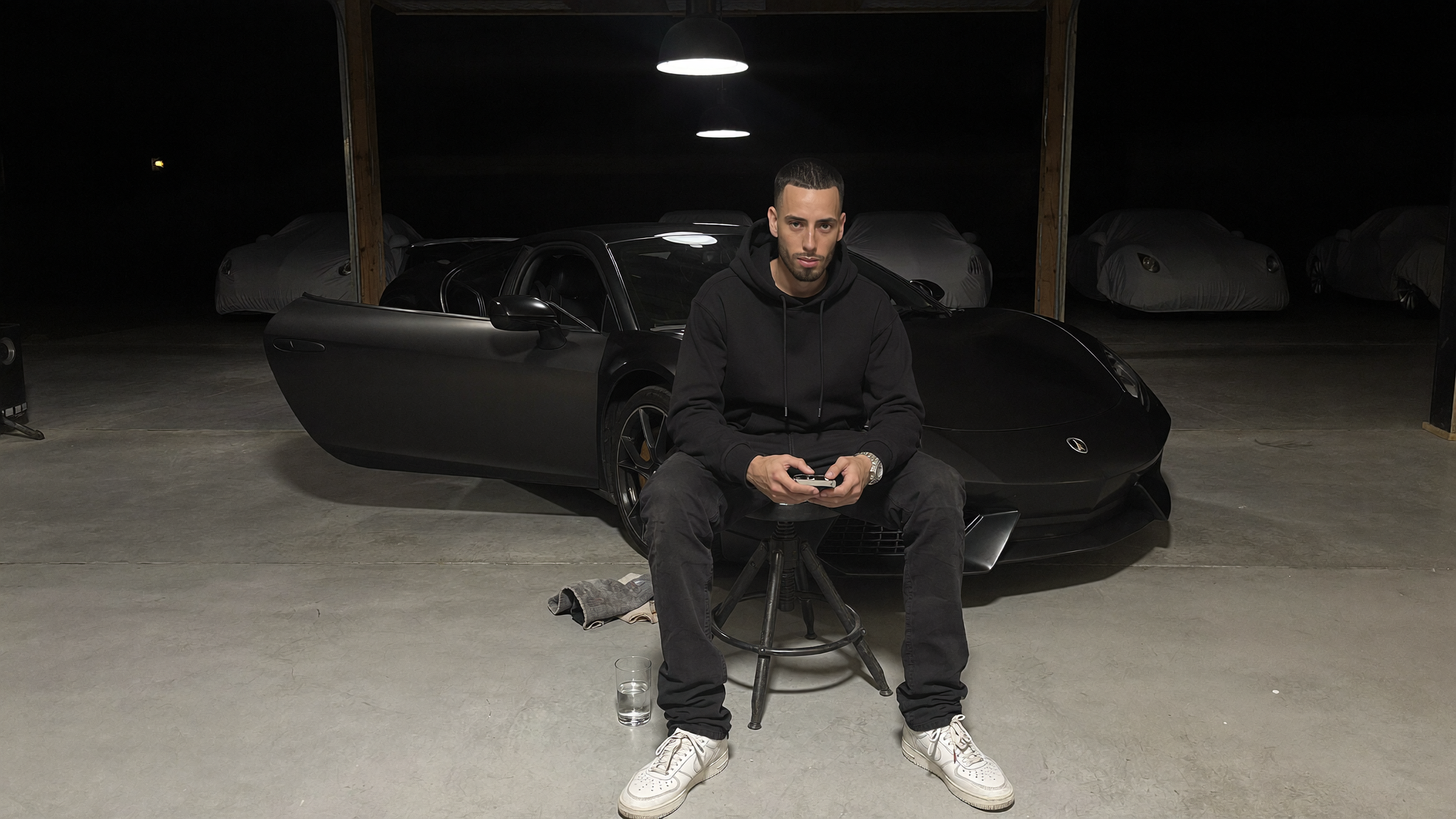
If you are going to use a car, do not touch it. Sit a few feet away, face away from it, and do something ordinary with your hands. The car stays in frame as context. This single change is the difference between a photograph and a dealership advertisement.
A genuine professional photograph of Cody Wise, not an illustration or render. A private collection garage at night, polished sealed concrete floor, a dark matte supercar parked at an angle behind him with the driver door closed, other covered cars barely visible in the darkness beyond. He sits on a low workshop stool a few feet in front of the car, elbows on his knees, turning a car key fob over in his hands with correct finger anatomy, not touching or posing on the car. A folded shop rag and a glass of water sit on the floor beside the stool. Wardrobe: luxury streetwear, a heavyweight washed black hoodie with realistic cotton weight and shoulder wrinkles, relaxed black trousers, premium white leather sneakers with visible creasing at the toe, a thin silver chain, a steel watch on the wrist. Lighting: two overhead industrial pendant lamps above and slightly behind the car, throwing hard pools of white light onto the car roof and the concrete, with the subject lit mainly by light bouncing off the pale floor so his face sits in soft lower-contrast illumination and the corners of the garage stay genuinely black with no fill. Camera: photographer standing about four metres away at seated eye level, crouched slightly, 35mm lens at f/2.8, full frame. Subject sharp, the car in soft focus but its body lines still readable, the far garage falling into darkness. Restrained natural grading, blacks allowed to go genuinely black, the specular highlights on the car paint left hot. Skin shows real pores, texture and slight asymmetry, no smoothing or beauty retouching. Candid documentary moment, not looking at camera. No readable text, badges or lettering on the car or anywhere in frame. No CGI look, no plastic skin, no fake film filter.
Creased sneakers and a shop rag
Two deliberately unglamorous details. Premium sneakers with visible creasing means they have been worn, and a shop rag on the floor means the space is used rather than staged. Wealth photography that contains nothing worn or used reads as a showroom, and showrooms belong to somebody else.
Wardrobe Rules for Luxury Frames
Six rules cover almost everything. They come from how the reference photography is actually styled, not from what is expensive.
- Name the fibre, not the brand. Cashmere with visible knit texture, linen that wrinkles as linen does, cotton with a real weave. Models render fibre behaviour well and brand names not at all.
- No logos, ever. This is both an aesthetic rule and a technical one. Quiet luxury has no visible branding by definition, and AI cannot draw a logo.
- Neutrals only. White, ivory, cream, oatmeal, sand, taupe, charcoal, navy. One palette per image.
- One piece of jewellery. A watch, or a chain. Not both plus rings plus a bracelet. Every extra metal object is another chance at a rendering artifact.
- Ask for wear. Creased sneakers, a softened collar, a worn leather strap. New everything reads as a costume.
- Do not mix archetypes. Quiet luxury and streetwear are two different visual languages. Pick one per frame. A cashmere crewneck with a chain and a fitted cap is neither.
If you want the broader technique behind varying scenes rather than wardrobe, our companion piece on wild AI photo prompts covers six scenes built on six different light sources, and the same discipline applies here.
The Credibility Line You Should Not Cross
Generating aspirational brand imagery is normal and always has been. Every magazine you have ever read is full of it. The line is not aesthetic, it is evidentiary: the moment a generated image is used as proof of something, it stops being styling and becomes a claim.
| Fine | Not fine |
|---|---|
| A moody terrace shot as a header image | The same shot captioned as your holiday |
| Luxury styling on a landing page | Implying a client paid for it |
| A generated portrait on a social profile | A generated portrait on a team page for staff who do not exist |
| Aspirational campaign creative | Screenshots or imagery presented as results |
| A car in frame as context | Saying the business bought it when it did not |
There is also a commercial argument, not just an ethical one. Wealth-signal marketing has been so thoroughly used by people selling courses that audiences now read it as a warning. If you are selling a real service, understated competence converts better than a jet, and it survives scrutiny. Use this aesthetic because it is beautiful, not because you want people to believe something untrue about you.
Never generate other people
Use your own likeness or someone who has agreed in writing. Do not generate recognisable public figures into luxury scenes, which is where a great deal of the viral version of this content sits. Personality rights are real, provincial privacy statutes cover commercial use of a person image, and platform rules on synthetic media keep tightening. This is not legal advice, and if synthetic imagery becomes central to your brand it is worth a proper review.
Common Mistakes
- Stacking signifiers. Jet plus watch plus car plus skyline in one frame is a collage, not a photograph.
- Naming brands in the prompt. You get garbled lettering and nothing else.
- Touching the expensive object. Leaning, straddling, arms spread. Rental body language.
- Everything brand new. No wear anywhere reads as a showroom.
- Sunglasses in every frame. They hide the identity your trained model exists to preserve.
- Direct eye contact with a half-smile. Turns editorial into cheap advertising instantly.
- Mixing quiet luxury with streetwear. Two different languages, pick one.
- Publishing the first generation. Check hands, the watch bracelet connection, and any surface that could have invented text.
Frequently Asked Questions
How do you make AI photos that look like a luxury lifestyle?
Build the frame from materials and light rather than from expensive objects. Name the fabric and how it behaves, name one dominant light source, keep the palette neutral, remove every logo, and give the subject an ordinary action that faces away from whatever the expensive thing is. Restraint is the entire aesthetic, so adding more signifiers makes the result worse rather than better.
Why do luxury AI photos look fake?
Usually because too many wealth signifiers are stacked into one frame, because attempted logos render as garbled lettering, because the subject is touching or posing with the expensive object, and because the lighting has no believable source. Real luxury editorial photography has one subject, one light source and almost no branding.
Should you put brand logos in an AI photo prompt?
No. Image models cannot render brand marks and produce melted lettering that immediately identifies the image as generated. It is also wrong for the genre, since quiet luxury brands are recognised by cut and fabric rather than visible branding. Name the fibre and the construction instead.
What is the best AI photo scene for looking wealthy?
A tight detail shot, such as a wrist and cuff, hands on a stone surface, or a cup on a worn table. Detail frames have no face or full-body proportions to get wrong, they are entirely texture, and texture is what actually signals quality. They survive close inspection far better than a wide shot in front of a jet or a car.
Is it dishonest to use AI luxury photos for your brand?
Aspirational styling is normal and every magazine does it. The line is evidentiary rather than aesthetic: it becomes dishonest when a generated image is presented as proof, such as a fabricated team page, a client result, a location you were never at, or an asset you do not own. Style freely, do not manufacture evidence.
The Bottom Line
The aesthetic people are chasing is not built from expensive things. It is built from linen that wrinkles, stone that has worn, one window doing all the lighting, and a subject who is not interested in the camera. Every instinct to add another signifier is the instinct to make the photograph worse. Strip it back, name the materials, name the light, and give yourself something ordinary to do.
And keep the line clear. Style your brand however you like. Do not use a generated image to prove something that did not happen.
Build the Visual System Behind the Look
A prompt gets you one image. A defined palette, a lighting signature, a wardrobe archetype and a documented prompt library get you a brand that looks the same in every asset for years. Wise Media builds that as part of our branding packages and applies it across your site and campaign creative through design packages. Tell us what you are building through the Wise Media intake form.