
The reason almost every AI brand photo looks the same is that almost every prompt names the same three locations: a cafe, a co-working space, a balcony at sunset. The scene is the cheapest variable in the whole prompt and the one people spend the least imagination on. Below are six that are not those, published in full, with the reasoning for why each one holds up.
Summary
- Wild does not mean surreal. Every scene here could be photographed tomorrow with a real crew and a real permit.
- The formula that generates interesting scenes: unexpected location, ordinary action, one dominant light source.
- Light is the lead variable. Six scenes with six different light sources produce six different-looking libraries from one trained model.
- Props carry the story. Six to eight specific named objects beat any amount of adjective stacking.
- Keep the camera, texture and negative blocks identical across every prompt. Only the top half should change.
- The strange scenes outperform the safe ones because a viewer has no reference image to compare them against.
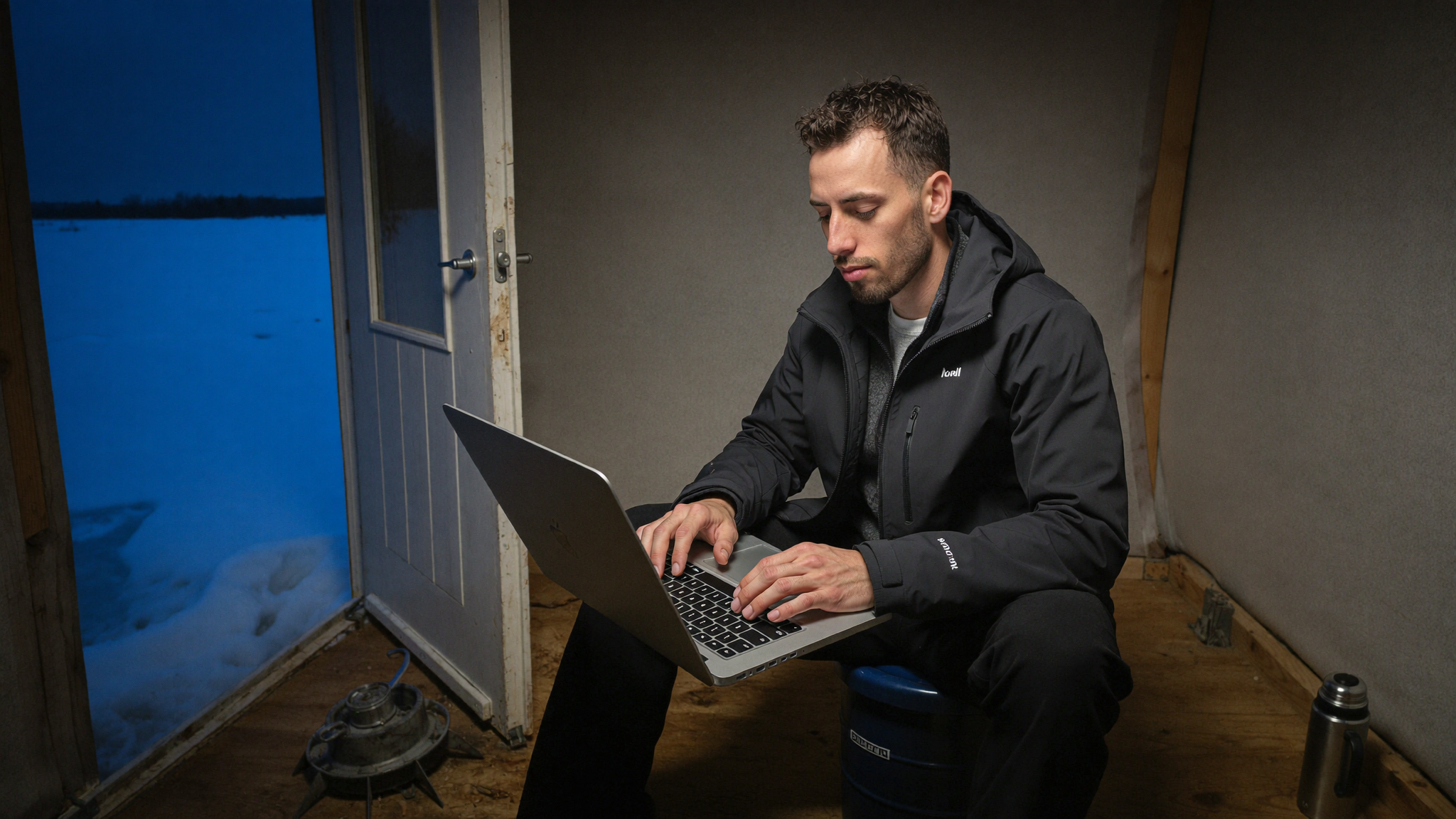
Table of Contents
- Why do AI brand photos all look identical?
- The formula for inventing a scene
- Prompt 1: the ice hut
- Prompt 2: the overgrown greenhouse
- Prompt 3: the 2am laundromat
- Prompt 4: the desert highway
- Prompt 5: the container port
- Prompt 6: the glacier
- Light is the lead variable
- How to go wild without going off brand
- Common mistakes
- Frequently asked questions
Why Do AI Brand Photos All Look Identical?
Because the prompt is written by someone thinking about the subject rather than about the photograph. Three specific failures repeat.
- The location is a category, not a place. A modern office is a category. A coin laundromat at 2am with one dryer running is a place. Models render categories as averages, and averages are what generic looks like.
- No dominant light source is named. If you do not say where the light comes from, the model invents an even, sourceless glow. That glow is the single most recognisable signature of AI imagery.
- The subject is doing nothing. Standing and smiling is not an action. Holding a paper map across your knees is. Actions give hands something to do, which quietly solves the hardest rendering problem in the frame.
Everything below is a fix for those three. If you want the underlying prompt architecture first, we covered the six-block structure and the trained-model workflow in how to make AI photos of yourself that do not look AI. This piece assumes you have that and wants to push the scenes further.
The Formula for Inventing a Scene
Unexpected location, ordinary action, one dominant light source. That is the whole thing. The tension between a strange place and a mundane activity is what makes a frame read as documentary rather than as a concept.
| Ingredient | Weak version | Strong version |
|---|---|---|
| Location | A modern workspace | An ice fishing hut on a frozen lake at blue hour |
| Action | Standing confidently | Crouched over a laptop balanced on an equipment case |
| Light source | Beautiful lighting | Laptop screen as the only light in the room |
| Props | Modern tech items | An auger, a dented thermos, a folded duffel bag |
One more rule that matters more than it sounds: pick locations you could plausibly be in. A viewer who knows you will forgive an invented place, but not an invented life. Everything in this set sits inside a range of environments a Canadian operator could actually turn up in.
Prompt 1: The Ice Hut
An ice fishing hut is a box with one door. That makes it the easiest place in the world to control light, because there is only one place light can come from. The laptop becomes the key light and the doorway becomes the fill, and the whole frame is built out of that single decision.
A genuine professional photograph of Cody Wise, not an illustration or render. Interior of a small ice fishing hut on a frozen lake at blue hour. Cody sits on an overturned bucket, leaning forward, an open laptop resting on his knees, both hands correctly placed on the keyboard with natural finger anatomy. A steel auger and a dented thermos sit on the plywood floor beside him. The hut door is cracked open on the left, showing deep blue twilight over the ice. Wardrobe: charcoal technical shell jacket, unzipped, over a merino base layer, with realistic fabric weight, seams and wrinkles. Lighting: two real sources only, the laptop screen throwing soft warm light upward onto his face and chest, and cold blue ambient skylight spilling through the open door onto the left side of his body. Shadows fall away from both sources consistently and the corners of the hut fall into genuine darkness with no fill. Camera: photographer crouched inside the hut roughly two metres away at seated eye level, 35mm lens at f/2.8, full frame. Cody is sharp, the far wall of the hut falls gently out of focus, the doorway retains recognisable detail. Restrained natural colour grading, believable dynamic range with the doorway highlight allowed to run bright. Skin shows real pores, texture and slight asymmetry, no smoothing or beauty retouching. Candid documentary moment, he is working rather than posing, not looking at the camera. No readable text on the screen. No CGI look, no plastic skin, no fake film filter.
Why it works
Two colour temperatures fighting each other. Warm screen light on the face against cold blue outside, which is a real cinematographic technique and something the model renders convincingly because it is a physically coherent instruction. Swap the ice hut for a tent, a van interior at night, or a fire lookout tower and the same structure holds.
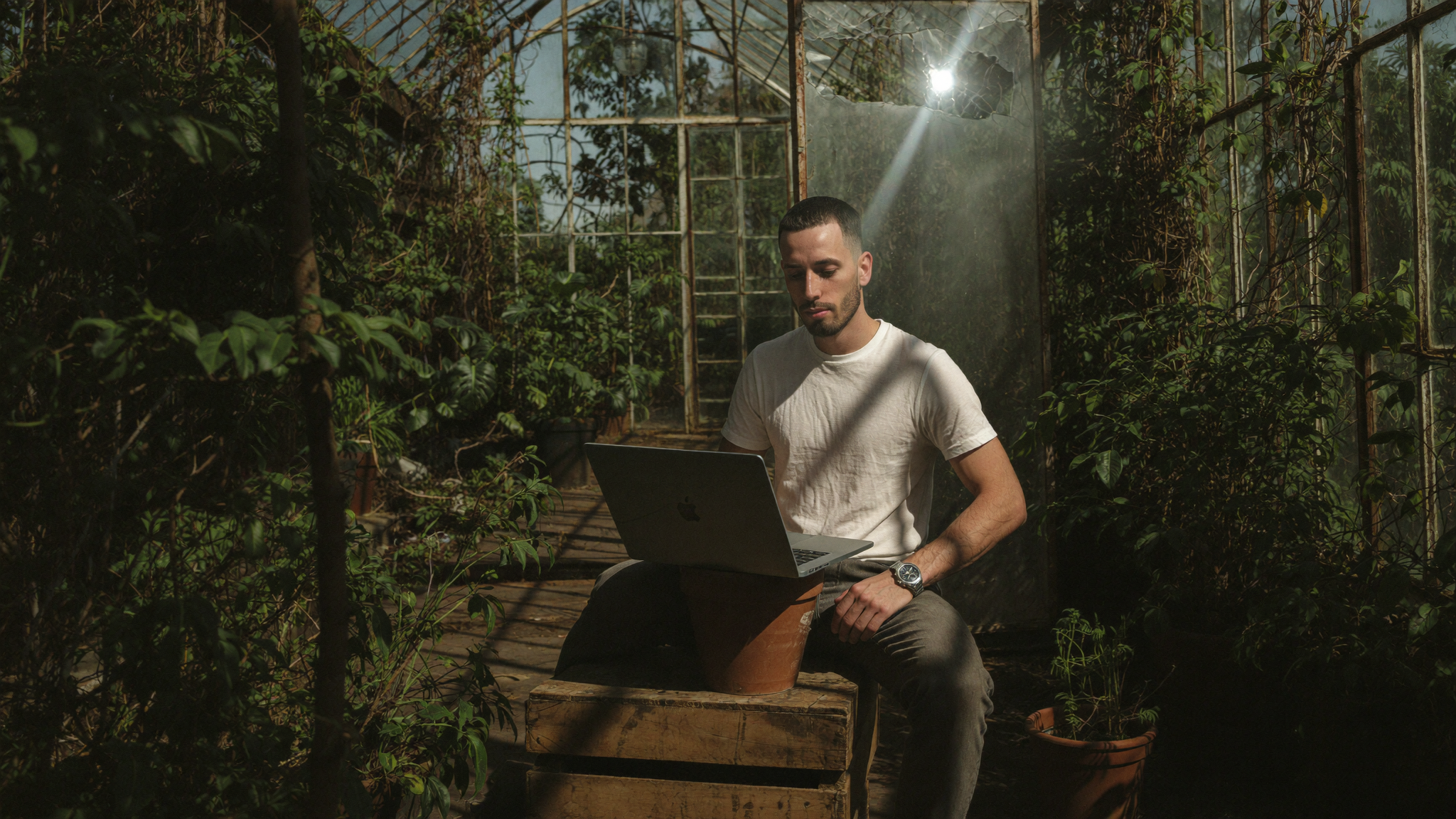
Prompt 2: The Overgrown Greenhouse
The opposite lighting problem. Instead of one small source in the dark, one hard shaft cutting through humid air. Naming the airborne particles is what makes the beam visible, and a visible beam is what sells the humidity.
A genuine professional photograph of Cody Wise, not an illustration or render. Interior of a humid overgrown Victorian glasshouse in mid afternoon. Cody sits on an upturned wooden crate, laptop balanced on a stack of terracotta pots, one hand on the trackpad and one resting on his thigh, correct hand anatomy and natural contact with the laptop. Dense tropical foliage and vines press in on both sides, cracked glass panes overhead, condensation beading on the glass. Wardrobe: premium off-white cotton t-shirt with realistic drape and wrinkles, stone-coloured relaxed trousers, a simple steel watch sitting correctly on the wrist. Lighting: a single hard shaft of afternoon sun entering through a broken pane above and behind camera-left, cutting diagonally across his shoulder and onto the floor, made visible by real airborne dust and humidity. Everything outside that shaft is lit only by soft green bounce from the foliage. Shadows are hard-edged where the shaft lands and soft everywhere else. Camera: photographer standing about three metres away at chest height, 50mm lens at f/2.8, full frame. Cody sharp, foliage in the immediate foreground softly out of focus, the far end of the glasshouse still legible. Restrained natural grading with believable greens, highlight on the sunlit shoulder allowed to clip slightly. Skin shows pores, faint sweat and natural imperfection, no smoothing. Candid working moment, not looking at camera. No readable text on the screen. No CGI look, no plastic skin, no fake film filter.
What to swap
Any enclosed space with a hard light source and something suspended in the air: a dusty workshop, a barn with gaps in the boards, a parking garage with one open bay. The instruction doing the work is visible dust and moisture in the light shaft. Delete that line and the image flattens immediately.
Prompt 3: The 2am Laundromat
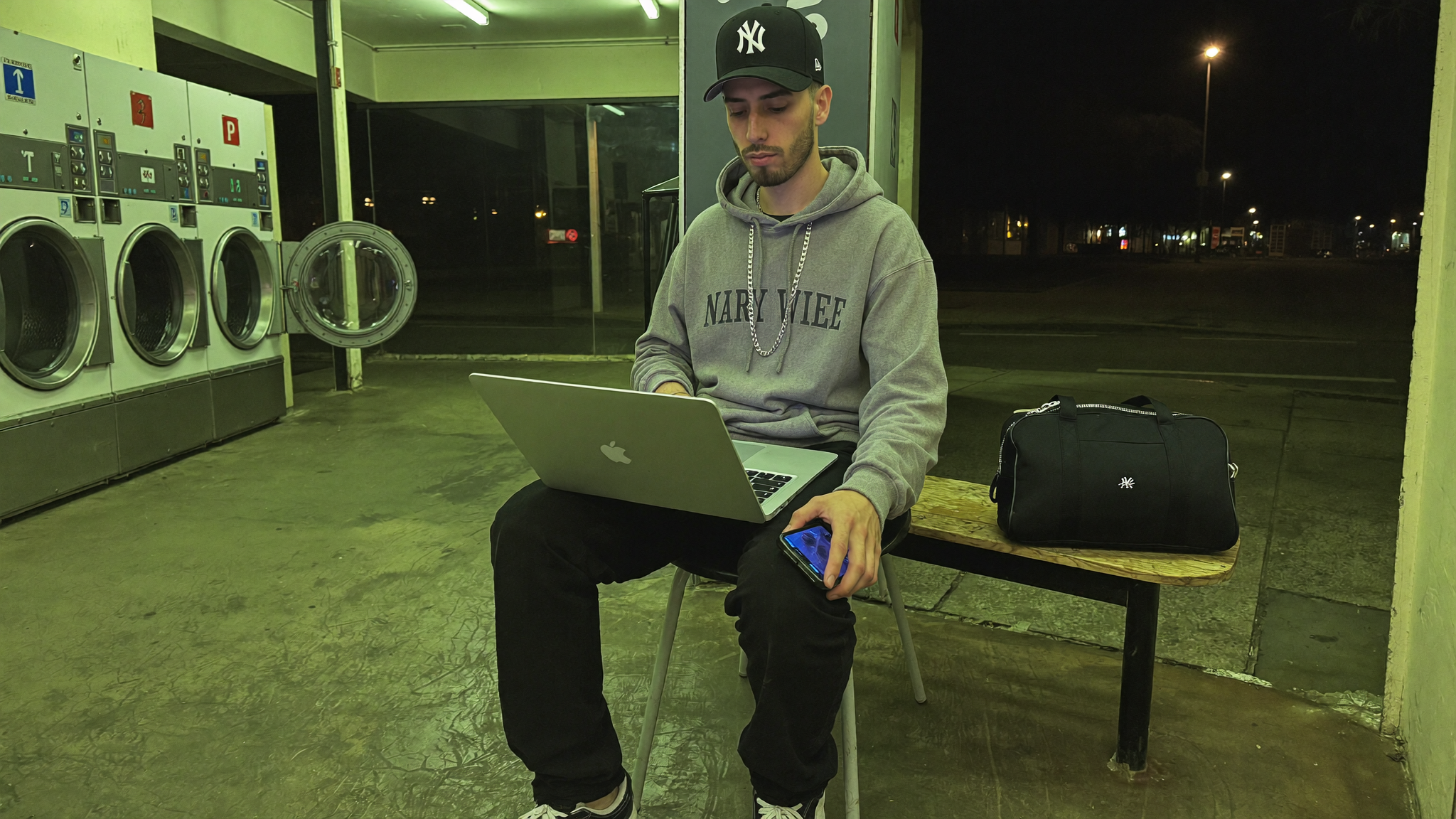
The least glamorous location in this set and probably the most effective. Fluorescent light is unflattering, which is exactly why it reads as real. Every instinct will tell you to make the lighting nicer. Do not.
A genuine professional photograph of Cody Wise, not an illustration or render. An empty coin laundromat at two in the morning. Cody sits low in a moulded plastic chair, laptop open on his knees, one hand on the keyboard and the other holding a phone face-up on his thigh, correct finger anatomy and natural grip on the phone. A single dryer drum is mid-rotation behind him, a black duffel bag sits folded on the bench, worn linoleum floor, dark empty street through the plate glass window behind. Wardrobe: black New York Yankees fitted cap, oversized washed grey hoodie with realistic heavy cotton weight and wrinkles, relaxed black trousers, a thin silver chain, premium white sneakers. Lighting: overhead fluorescent tubes only, slightly green, throwing flat top-down illumination with hard short shadows under the brow and nose, plus a faint cool spill from the phone screen. The street outside is genuinely dark with only distant streetlight. Camera: photographer standing about three metres away at standing eye level looking slightly down, 35mm lens at f/4, full frame. Cody sharp, the dryers and window behind retain recognisable detail rather than heavy blur. Restrained grading, no attempt to flatter the fluorescent colour. Skin shows pores, late-night fatigue, natural oil and asymmetry, no smoothing or beauty retouching. Candid documentary moment, not looking at camera. No readable text on the screen or on any signage. No CGI look, no plastic skin, no fake film filter.
Why the ugly light is the point
Beauty lighting is the thing viewers have been trained to distrust, because it is what every generated image defaults to. A slight green cast and hard shadows under the brow are the kind of detail nobody would ask for unless they were describing something they had actually seen. That is the tell that runs in your favour.
Prompt 4: The Desert Highway
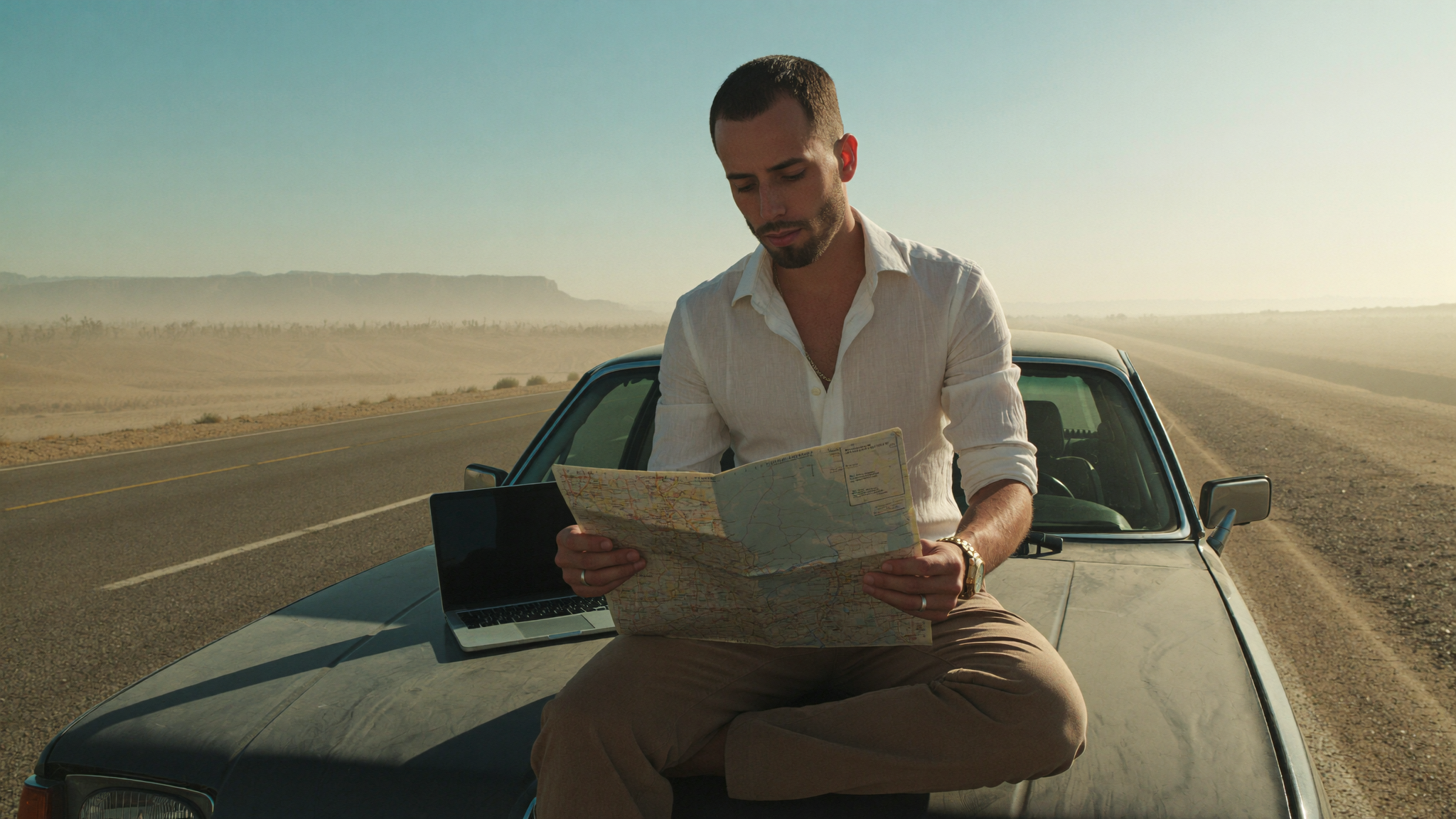
The long-lens frame in the set. An 85mm with heat shimmer and hanging dust compresses the background into a wall of haze, which does more for the sense of place than any amount of scenery description.
A genuine professional photograph of Cody Wise, not an illustration or render. The shoulder of an empty desert highway in late afternoon. Cody sits cross-legged on the hood of a dust-covered older sedan, a closed laptop beside him, holding a folded paper road map open across his knees with both hands, correct hand anatomy and realistic paper tension and creasing. Heat shimmer rises off the asphalt, distant mesas are barely legible through hanging dust. Wardrobe: white linen shirt with sleeves rolled, genuinely wrinkled as linen behaves, sand-coloured relaxed trousers, a gold-toned dress watch sitting correctly on the wrist. Lighting: low sun behind and camera-right, filtered through airborne dust, producing a warm rim along his shoulders and the side of his jaw, with the front of his body lit by soft bounce off the pale hood and road surface. Shadows run long toward camera-left. Camera: photographer standing about eight metres away at chest height, 85mm lens at f/4, full frame, giving natural compression. Cody sharp, the car hood falling off gently, the horizon soft from atmospheric haze rather than lens blur. Restrained warm grading, no teal and orange, sky highlight allowed to run bright. Skin shows pores, sweat, dust and natural imperfection, no smoothing. Candid moment, he is reading the map, not looking at camera. No readable text anywhere. No CGI look, no plastic skin, no fake film filter.
The closed laptop
Closing the laptop and putting a paper map in his hands is the most deliberate choice in this prompt. It gives the hands a defined task, it removes the screen glow that would fight the sun, and it tells a small story that a laptop open on a car hood would not. Give the hands a job in every prompt you write.
Prompt 5: The Container Port
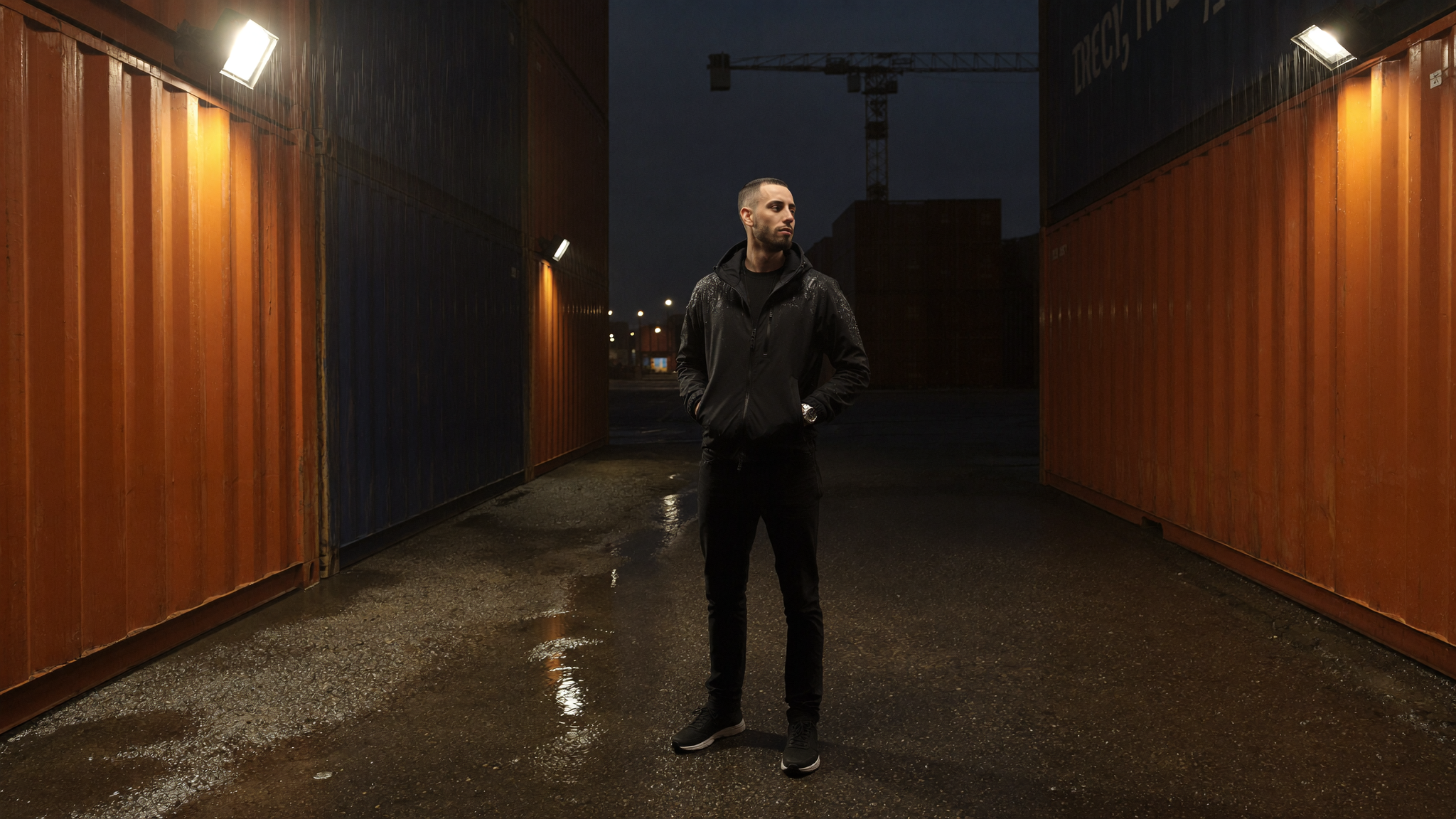
No laptop in this one, which is worth doing at least once in any set. A frame where the subject is simply standing in a place, looking at something outside the frame, gives you an image you can use as a header or an about-page hero without it reading as a stock working shot.
A genuine professional photograph of Cody Wise, not an illustration or render. A shipping container yard at night in light rain. Cody stands in the canyon between two stacked container walls, hands in the pockets of his jacket, head turned up and away from camera looking toward the top of the stack. Wet asphalt reflects the lights overhead, rain is visible falling through the beams, a gantry crane is silhouetted far behind. Wardrobe: black technical waterproof shell with the hood down, water beading realistically on the shoulders and sleeves, dark trousers, premium black sneakers, a steel watch on the wrist. Lighting: high sodium vapour floodlights mounted above and camera-left, hard amber, producing strong top light on his shoulders and cheekbone, deep unfilled black shadow on the shadow side, and long specular reflections in the wet ground. No other light source. Camera: photographer standing about six metres away at standing eye level, 35mm lens at f/2.8, full frame. Cody sharp, the container walls receding into focus falloff and darkness, crane soft in the background. Restrained grading, amber cast left honest, blacks allowed to go genuinely black without lifting. Skin shows pores, rain on the surface, natural texture and asymmetry, no smoothing. Candid documentary moment. No readable text or lettering on the containers. No CGI look, no plastic skin, no fake film filter.
Wet surfaces are free production value
Rain and wet asphalt give the model a reason to render reflections, and reflections are one of the strongest realism cues available because they force the lighting to be internally consistent. Any night exterior improves the moment you add light rain and wet ground. Note also the explicit instruction against lettering on the containers, because container stacks are exactly the kind of surface a model will cover in invented text.
Prompt 6: The Glacier
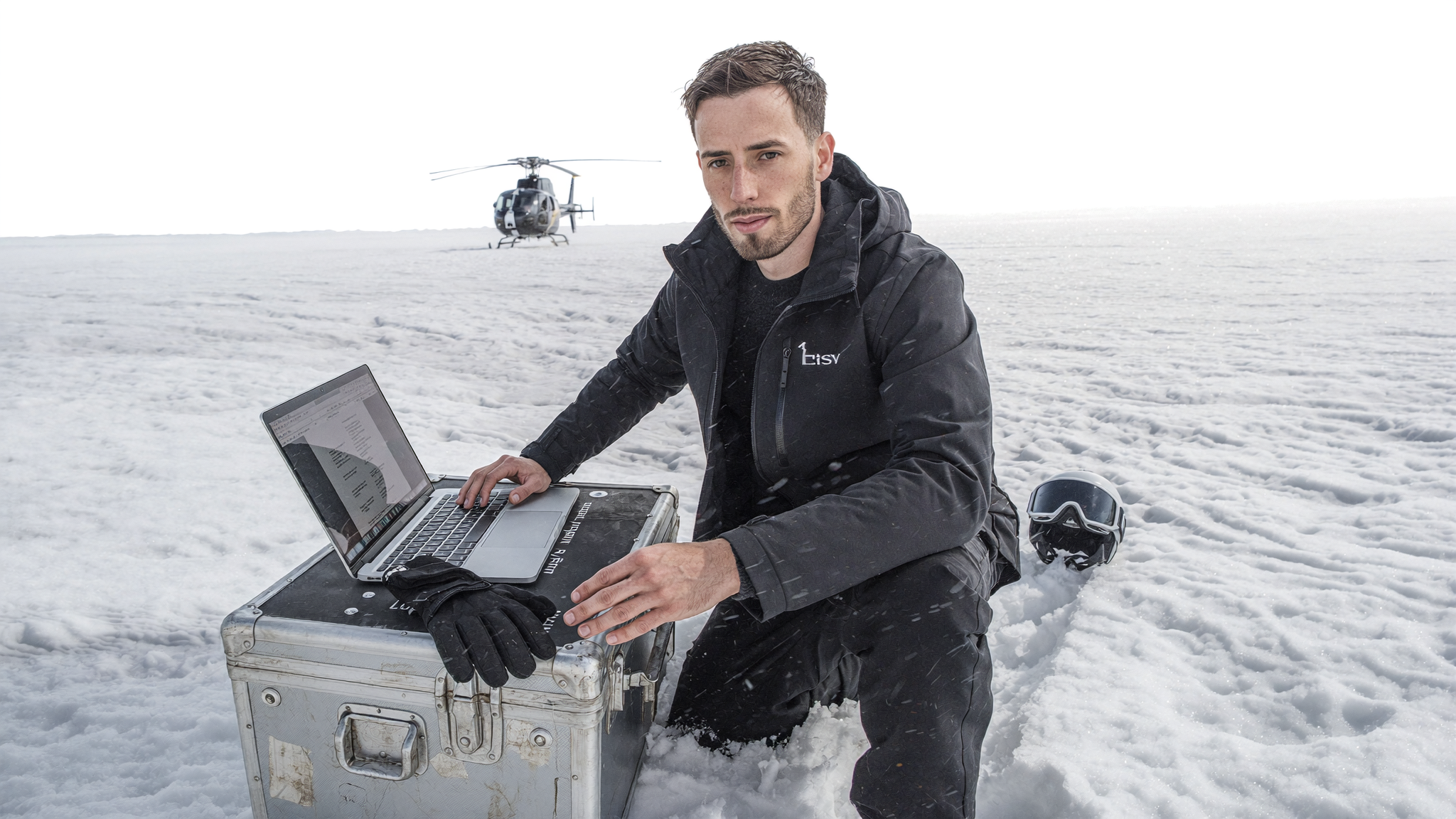
The hardest lighting condition in the set. Flat overcast on snow has almost no shadow direction, which strips away the usual crutches and puts everything on skin texture and colour. If a trained likeness model is going to fall apart anywhere, it is here.
A genuine professional photograph of Cody Wise, not an illustration or render. A high glacier snowfield under heavy overcast. Cody crouches on one knee beside a battered aluminium equipment case with a laptop open on its lid, one bare hand on the trackpad and the other steadying the case lid, correct hand anatomy and realistic contact. A ski helmet and goggles rest in the snow beside him, a helicopter sits parked and out of focus far behind. Wind lifts loose spindrift across the surface. Wardrobe: black insulated technical shell unzipped over a dark merino layer, technical snow trousers, one glove removed and tucked under his arm, all fabric behaving like real technical outerwear with visible seams, taped edges and wind-driven wrinkles. Lighting: flat high-key overcast daylight with almost no directional shadow, plus very strong white bounce from the snow filling under the jaw and brow. Camera: photographer standing about four metres away at chest height looking slightly down, 50mm lens at f/5.6, full frame. Cody sharp, the helicopter and horizon soft from distance and blowing snow rather than shallow aperture, snow surface detail retained in the foreground. Restrained grading, the white sky allowed to blow out as a real camera would, snow kept genuinely white and not blue. Skin shows pores, windburn, chapped lips and natural imperfection, no smoothing or beauty retouching. Candid working moment, not looking at camera. No readable text on the screen. No CGI look, no plastic skin, no fake film filter.
Ask for damage
Windburn, chapped lips, a reddened face. Every model wants to give you flawless skin, and asking explicitly for weather damage is one of the most reliable ways to override that. The same trick works elsewhere: sweat in heat, dust on clothing, rain on the skin. Environmental damage is the cheapest realism instruction there is.
Light Is the Lead Variable
Six scenes, six light sources, six completely different-looking images from one trained model and one unchanged tail block. If you only vary one thing in your prompts, vary this.
| Scene | Light source | Palette | Lens |
|---|---|---|---|
| Ice hut | Laptop screen, blue twilight fill | Warm face, cold surround | 35mm |
| Greenhouse | Single hard shaft through humid air | Green and gold | 50mm |
| Laundromat | Overhead fluorescent, green cast | Flat and clinical | 35mm |
| Desert highway | Low backlit sun through dust | Orange haze | 85mm |
| Container port | Sodium vapour from above, wet reflections | Amber and black | 35mm |
| Glacier | Flat overcast with snow bounce | High-key white | 50mm |
How to Go Wild Without Going Off Brand
Strange scenes are only useful if they still look like the same brand. Four constraints keep a wild set coherent.
- Fix the grade. Same film stock reference and same grain in every prompt. This is what makes six unrelated locations feel like one body of work.
- Fix the wardrobe palette. Black, white, grey and one accent. The locations can be anything if the person in them is consistent.
- Fix the framing language. Candid, unposed, documentary, rarely looking at camera. A set that mixes candid and posed-to-camera reads as a stock library.
- Keep the closing block consistent. The skin-texture line and the negatives should be copy-pasted every time. The camera line changes with the composition, but everything after it should not.
That discipline is the difference between a brand and a mood board. It is the same argument we make about visual systems generally in how to make a website feel premium, and the reason a documented system beats a good eye over any horizon longer than a month.
Where the strange scenes actually go
Not everywhere. Use them for article headers, social, section breaks and campaign creative, where the job is to stop a scroll. Keep the plain environmental shots for about pages, team sections and anything a client might read as documentation. A glacier shot on your services page is fine. A glacier shot captioned as your office is not.
Common Mistakes
- Making the strange scene beautiful. The impulse to soften the fluorescent light or add a sunset ruins the exact quality that made the location work.
- Changing the tail block between prompts. Then you are debugging two variables at once and cannot tell which change caused what.
- Locations you could never plausibly be in. An invented place is fine. An invented life is not, and people who know you will feel it.
- Leaving surfaces unguarded. Container stacks, signage, screens and packaging all attract invented text. Name them in the negatives.
- Two people in frame. A trained likeness model handles one subject. Add a second and both faces degrade.
- Using the wild set for documentary claims. Team pages, premises and case studies are the wrong place for a glacier.
- Publishing the first generation. Check hands, hairline, and the fade for an invented razor line before anything ships.
Frequently Asked Questions
What makes a good AI photo prompt?
An unexpected but plausible location, an ordinary action that gives the hands something specific to do, and one named dominant light source. Add six to eight specific props, a real camera body and lens, and a fixed block of negatives. Adjectives like cinematic and stunning contribute almost nothing next to any one of those.
How do you stop AI images from looking generic?
Stop naming categories and start naming places. A modern office is a category and renders as an average. A coin laundromat at two in the morning with one dryer running is a place, and the model has something specific to build from. Then name where the light comes from, because an unnamed light source is what produces the even sourceless glow that reads as AI.
Should every AI brand photo show you working on a laptop?
No, and a set where every frame does looks like stock. Include at least one image with no device at all, where the subject is simply standing in a place looking at something outside the frame. Those are the frames that work as page headers and about-page heroes, because they carry mood rather than activity.
How do you keep a set of AI images looking like one brand?
Fix four things across every prompt: the colour grade and film stock reference, the wardrobe palette, the framing language, and the entire camera and negatives tail block. Vary only the location, the action and the light. Six wildly different places will still read as one body of work if those four are constant.
What is the fastest way to make AI skin look real?
Ask for environmental damage. Windburn and chapped lips in cold, sweat and dust in heat, rain on the skin at night. Every model defaults to flawless skin, and requesting specific weather damage overrides that default more reliably than any general instruction about realism or texture.
The Bottom Line
Wild scenes are not a stylistic flourish, they are a cheaper way to be memorable. The tail block of a prompt is where the realism lives, and it never has to change. The top half is where the interest lives, and it costs you one sentence to move from a cafe to an ice hut. Most people spend all their effort on the half that should stay fixed and none on the half that should not.
Build the Library, Not Just the Image
One prompt gives you one photograph. A fixed grade, a wardrobe palette, a framing language and a documented tail block give you a brand that still looks like itself in two years. Wise Media builds that system as part of our branding packages and rolls it across your site and campaign creative through design packages. Tell us what you are building through the Wise Media intake form.