
Unless a designer signed a written assignment, they still own the copyright in your logo. Paying the invoice does not transfer it. Under section 13(1) of the Copyright Act the author is the first owner, and section 13(4) says no assignment is valid unless it is in writing signed by the owner. Most Canadian small businesses are using a logo they do not legally own.
Last updated 23 September 2026. Written by Cody Wise, founder of Wise Media. General information, not legal advice. Verify your position with an intellectual property lawyer.
Summary
- The author owns it first. Section 13(1) of the Copyright Act makes the author the first owner. Commissioning and paying does not change that.
- Written and signed, or it did not happen. Section 13(4) invalidates any assignment that is not in writing signed by the owner of the right or their authorized agent. A verbal agreement, an email saying “you own it”, and an invoice marked paid are not assignments.
- The commissioned-works shortcut was repealed in 2012. Old section 13(2) used to give the person who ordered and paid for an engraving, photograph or portrait the copyright. The Copyright Modernization Act repealed it, so the general rule now applies.
- Employees are different. Section 13(3) gives the employer first ownership of work made in the course of employment under a contract of service, absent an agreement to the contrary. Contractors are not employees.
- Moral rights survive assignment. Section 14.1(2) says moral rights may not be assigned, only waived, and 14.1(3) says assigning copyright does not by itself waive them. You need a separate written waiver.
- Copyright is not a trademark. Owning the copyright in the artwork and owning the brand rights to use the mark in commerce are two different things, obtained two different ways.
- Section 14 puts a 25-year clock on it. Where the author was first owner, an assignment made otherwise than by will does not vest rights beyond 25 years after the author’s death, and the reversionary interest goes to the author’s estate notwithstanding any agreement to the contrary.

Table of Contents
- Who owns a commissioned logo in Canada?
- Employee, contractor, agency or freelancer
- What a real assignment clause looks like
- Moral rights, and why assignment alone is not enough
- Copyright is not a trademark
- The 25-year reversion nobody mentions
- Common mistakes
- Frequently asked questions
- The bottom line
Who Owns a Commissioned Logo in Canada?
The designer, until they sign something that says otherwise. Section 13(1) of the Copyright Act is one sentence: subject to this Act, the author of a work shall be the first owner of the copyright therein. Artistic works, which include logos and other graphic designs, get copyright automatically on creation. No registration, no filing, no fee.
What trips up business owners is the assumption that a commercial transaction transfers ownership. It does not. Paying for the work buys you whatever the contract says you bought. If the contract is silent, courts read that as a licence to use the work for the purpose it was commissioned, not a transfer of the copyright itself.
The rule that changed in 2012, and why old advice is wrong
Until 2012 there was a carve-out. Old section 13(2) provided that where an engraving, photograph or portrait was ordered and paid for, the person who ordered it was the first owner of the copyright. The Copyright Modernization Act repealed it, and ownership reverted to the general rule in 13(1).
That is why the wedding photographer, not the couple, owns the photographs. It is also why a lot of Canadian business advice on the internet is out of date: articles written before 2012, or copied from articles written before 2012, still describe a rule that has not existed for over a decade. The repeal carried a transitional provision, so the old subsection continues to apply to works commissioned before it came into force, but for anything commissioned since, the author owns it.
A logo was never inside that carve-out anyway. Logos are artistic works, not engravings, photographs or portraits, so the author has been the first owner the whole time.
Employee, Contractor, Agency or Freelancer?
Ownership turns on the relationship, and only one of the four gives you copyright by default.
| Who made it | Who owns the copyright by default | What you need |
|---|---|---|
| Your employee, in the course of employment | You, the employer, under s.13(3), absent an agreement to the contrary | A moral rights waiver. Ownership is already yours |
| A freelance designer | The designer | Written signed assignment plus moral rights waiver |
| An agency that subcontracted the work | Whoever actually drew it, unless the agency took an assignment | Assignment from the agency, and proof the agency holds it from the subcontractor |
| An AI generation tool with no human author | Unsettled in Canada | Human authorship in the final mark, and a documented creative process |
| You, the business owner, personally | You personally, not your corporation | An assignment from you to the company. Two separate legal persons |
Two rows there catch people who thought they were safe.
The subcontractor chain. You hired an agency and the agency’s contract assigns you everything. Fine, as long as the agency actually held the copyright to assign. If they subcontracted the illustration to a freelancer without taking a written assignment, the agency never owned it, so the assignment to you transferred nothing they had. You cannot assign what you do not hold. Ask the question in writing during the engagement, not during diligence.
Founder-drawn logos. If you sketched the mark yourself before incorporating, you own it personally. Your corporation is a separate legal person. This is the single most common gap that surfaces in a financing or an acquisition, and it is also the easiest to fix while everyone is still friendly.
The AI-generated wrinkle
Copyright in Canada attaches to works with a human author who exercised skill and judgment. Where the creative choices were made by a model in response to a prompt, whether copyright subsists at all, and who would own it, is unsettled. That is a separate problem from registrability as a trademark, which we covered in can I trademark an AI-generated logo in Canada. The practical guidance is the same in both cases: keep a record of the human creative work, and do not build a brand on a mark whose provenance you cannot document.
What a Real Assignment Clause Looks Like
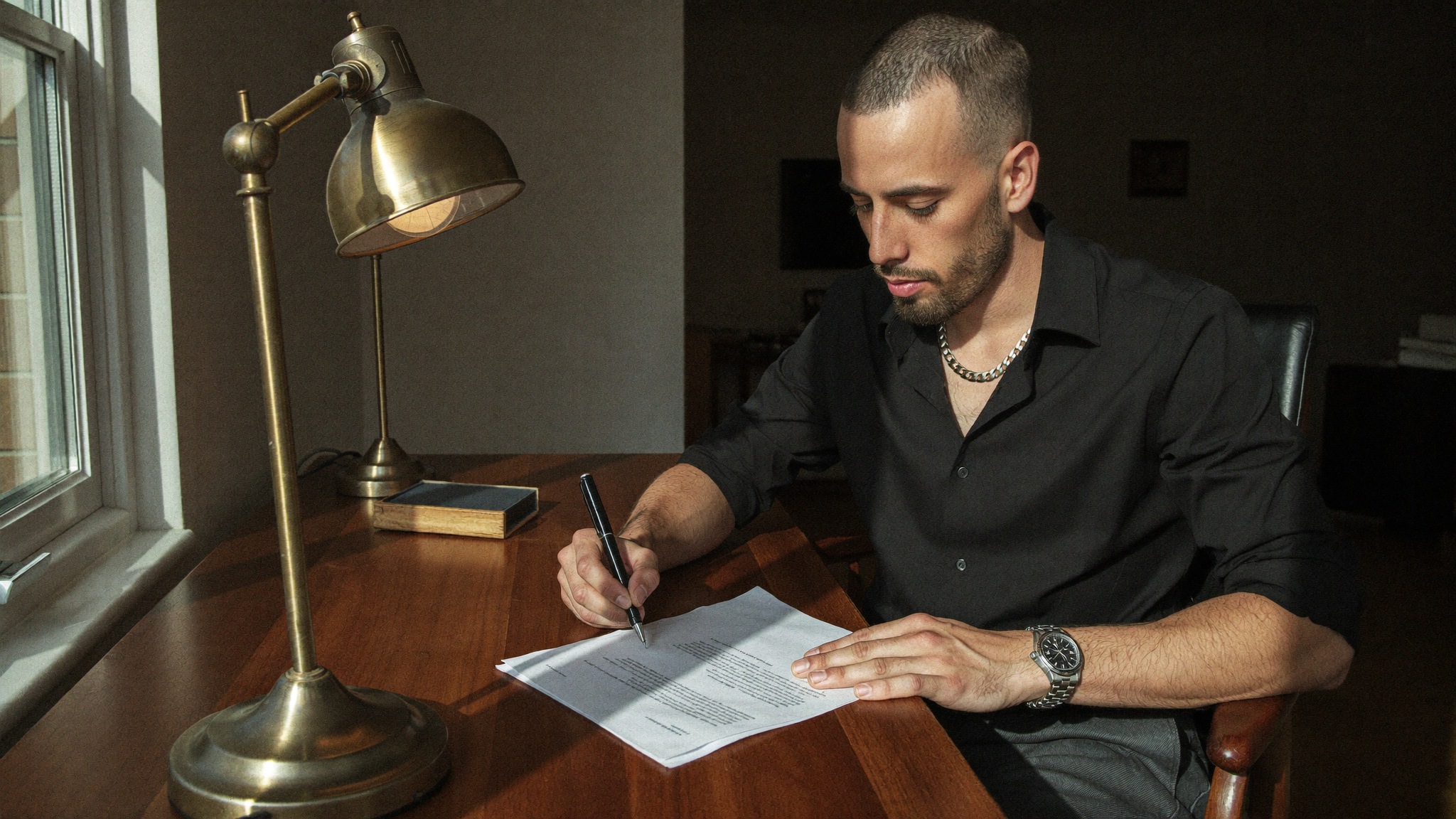
Section 13(4) sets the bar: no assignment or grant is valid unless it is in writing signed by the owner of the right in respect of which the assignment is made, or by the owner’s duly authorized agent. That is the whole test. Written. Signed. By the person who holds the right.
The same subsection also confirms that an assignment can be partial: limited by territory, by medium, by sector of the market, or by term. That flexibility is why so many design contracts hand over less than the client assumes. A clause granting “exclusive use in Canada for print and digital marketing” is a limited licence, and it is doing exactly what it says.
The seven-point checklist
- The word assigns, not grants or licenses. “The Designer hereby assigns to the Client all right, title and interest in the copyright.” A licence is not ownership, no matter how exclusive or perpetual.
- Worldwide, all media, full term. Silence on scope invites the partial-assignment reading in s.13(4).
- A defined list of what is covered. The final mark, every lockup and variant, the wordmark, icon-only versions, colour and monochrome, and the working files. Name them.
- A separate moral rights waiver. Covered in the next section. It is a distinct clause, not a sub-point.
- Signatures from the right parties. If an agency is signing, they must already hold what they are assigning. If a subcontractor drew it, get their signature too, or get written confirmation of the upstream assignment.
- Delivery of working files. Layered vector source, not just exported PNGs. Copyright ownership and file possession are separate problems, and you can lose the second while winning the first.
- A third-party warranty. The designer warrants the work is original and does not infringe, including any licensed fonts or stock elements embedded in it.
The font licence trap
A wordmark built from a licensed typeface carries that typeface’s licence terms with it. Some desktop font licences do not permit use in a logo, and some require a separate and considerably more expensive logo or embedding licence. Getting a clean copyright assignment on the artwork does not clear the font underneath it. Ask for the font licence name and tier in writing alongside the assignment, and keep both with the brand files.
This is the layer where an all-in branding package earns its price against a marketplace logo: the deliverable includes the assignment, the waiver, the source files and the font licensing position, documented, rather than a ZIP of PNGs and a hope.
Moral Rights, and Why Assignment Alone Is Not Enough
Section 14.1 of the Copyright Act gives the author two things that have nothing to do with ownership: the right to the integrity of the work, and the right, where reasonable in the circumstances, to be associated with the work as its author by name or pseudonym, or to remain anonymous.
Then it says two things that matter enormously to a logo buyer. Subsection 14.1(2): moral rights may not be assigned, but may be waived in whole or in part. Subsection 14.1(3): an assignment of copyright in a work does not by that act alone constitute a waiver of any moral rights.
Read together, that means a perfect, fully signed copyright assignment can still leave the designer holding an integrity right over the mark. Every practical thing a growing business does to a logo touches integrity: recolouring it for a sub-brand, cropping to an icon for an app tile, flattening it for embroidery, animating it, stretching it across a vehicle wrap, placing it against a photograph.
Subsection 14.1(4) is the piece your agency needs too: where a waiver is made in favour of an owner or licensee of copyright, it may be invoked by any person authorized by that owner or licensee to use the work, unless the waiver says otherwise. So a properly drafted waiver in your favour also covers the printer, the sign shop and the marketing agency you hand the files to.
Section 14.2 sets the term: moral rights subsist for the same term as the copyright in the work, and on the author’s death they pass by bequest or, failing that, to whoever takes the author’s estate. They do not quietly lapse when the designer moves on.
Attribution, in practice
The attribution right is qualified by “where reasonable in the circumstances”, and nobody expects a credit line beside a logo on a storefront. It still gets negotiated, usually as the designer asking to keep the work in a portfolio and to be credited in case studies. That is a reasonable trade for a full waiver, and writing it in is faster than arguing about it later.
Copyright Is Not a Trademark
These are different rights, obtained differently, protecting different things. Confusing them is the second most common error after assuming payment transfers ownership.
| Copyright | Trademark | |
|---|---|---|
| Protects | The artwork itself as an original expression | The mark as a source identifier in commerce |
| How you get it | Automatic on creation | Through use, and registration with CIPO for the strongest position |
| Term | Life of the author plus 70 years from the end of that calendar year | Registration renewable in ten-year terms, indefinitely, while in use |
| What it stops | Copying and reproduction of the artwork | Confusingly similar marks used with related goods or services |
| Registration | Optional, cheap, useful as evidence | Optional in theory, close to essential in practice |
You can hold clean copyright in a logo and still be unable to stop a competitor from using a confusingly similar mark. You can hold a registered trademark and still be infringing someone else’s copyright in the drawing. Most brands want both, and the sequencing matters: get the assignment first, because applying to register a mark you do not own is a problem you have paid to create. The distinction between the drawing and the brand system around it is the same one we drew in the difference between a logo and a brand identity.
The 25-Year Reversion Nobody Mentions
This one is genuinely obscure and it sits in section 14(1) of the Act. Where the author of a work is the first owner of the copyright, no assignment made by them, otherwise than by will, is operative to vest in the assignee any rights beyond twenty-five years from the death of the author. The reversionary interest devolves on the author’s legal representatives as part of the estate, and, in the Act’s own words, any agreement entered into by the author as to the disposition of that reversionary interest is void.
Notwithstanding any agreement to the contrary. You cannot contract around it. Copyright runs for the author’s life plus 70 years, and an assignment from an author who was the first owner reaches only 25 of those post-death years, after which the balance reverts to the estate.
For most businesses this is a distant problem rather than an urgent one, and it is worth knowing exactly because so few advisors raise it. Two practical notes. It applies where the author was the first owner, so an in-house logo drawn by an employee, where the employer is first owner under s.13(3), is outside it. And section 14(2) carves out assignments of copyright in a collective work. If your brand is old enough that the original designer has been gone for decades, this is worth an actual legal opinion rather than a blog paragraph.
It is also a good argument for holding a registered trademark rather than relying on copyright alone as the durable right in a brand. A trademark renews indefinitely while it is in use. Copyright does not.
How to Audit What You Actually Own
- Find the contract. The original engagement agreement, statement of work or proposal that the designer signed. Not the invoice.
- Search it for the word “assign”. If the document says licence, grant, use, or full rights without the word assigns, treat it as a licence until a lawyer tells you otherwise.
- Check for a moral rights waiver. A separate clause. If the only mention of moral rights is inside the assignment sentence, it likely is not a waiver.
- Trace the actual author. Ask who drew it. If it was a subcontractor, you need the upstream chain.
- Confirm the signature. Signed by the person or entity that held the right, not by an account manager with no authority.
- Locate the source files. Layered vector originals. If you only have exports, you have a practical problem alongside the legal one.
- Check the fonts. Which typeface, which licence tier, and does it permit logo use.
- Check the corporate entity. Is the assignee the company that trades today, or a predecessor, or you personally.
Anything that fails a step is fixable now and expensive to fix later. The cheapest moment to get a confirmatory assignment signed is while the designer still likes you. The most expensive is during an acquisition, when the buyer’s counsel finds the gap and the designer discovers they have leverage.
Common Mistakes
- Treating the paid invoice as proof of ownership. It proves payment. Nothing in section 13 makes payment an assignment.
- Accepting “full rights” or “unlimited usage”. Neither phrase is an assignment. Both describe a licence.
- Assuming the moral rights waiver came with the assignment. Section 14.1(3) says it did not.
- Buying a marketplace logo and skipping the terms. Contest platforms and template marketplaces vary enormously. Some transfer copyright on payment, many grant a licence, and some resell the same mark. Read what you bought.
- Letting the founder own it personally. Two legal persons. Assign it into the company.
- Ignoring the subcontractor chain. An agency cannot assign a right it never held.
- Registering the trademark before securing the copyright. Sequencing matters, and doing it backwards is a self-inflicted problem.
- Losing the working files. Legally irrelevant, operationally fatal. Rebuilding a vector from a 900-pixel PNG is a real cost.
- Never writing any of it down. A brand asset with no paper trail is a diligence finding waiting to happen.
Frequently Asked Questions
I paid for my logo. Do I own the copyright?
Not unless a written assignment was signed. Section 13(1) of the Copyright Act makes the author the first owner, and section 13(4) requires any assignment to be in writing signed by the owner of the right. Payment on its own buys you whatever the contract granted, which is usually a licence to use the work for the purpose it was commissioned.
Can I get an assignment signed after the fact?
Yes, and you should. A confirmatory assignment signed years later is entirely valid, and it is usually straightforward while the relationship is still good. Include the moral rights waiver in the same document. The designer has no obligation to sign, which is exactly why doing it early costs nothing and doing it late can cost a great deal.
Do I need to register my logo copyright in Canada?
No. Copyright arises automatically on creation, with no registration requirement. Registration with the Canadian Intellectual Property Office is optional and relatively inexpensive, and it gives you a certificate that serves as evidence of ownership, which is useful in a dispute. It is not what creates the right.
What is the difference between a copyright assignment and an exclusive licence?
An assignment transfers ownership. An exclusive licence leaves ownership with the author and grants you exclusive permission to use the work, usually within defined limits of territory, medium or term. Section 13(7) of the Act confirms an exclusive licence is a grant of an interest in the copyright, not a transfer of it. If you want to be able to sell, sub-licence or enforce the right yourself, you want the assignment.
Does my designer keep the right to show my logo in their portfolio?
That depends on the contract and on whether moral rights were waived. Portfolio and attribution rights are commonly reserved by designers and are usually a reasonable trade. Write the permission and its limits into the agreement explicitly rather than leaving it to be inferred.
Who owns the logo if my employee designed it?
Under section 13(3), where the author was in your employment under a contract of service and made the work in the course of that employment, you are the first owner of the copyright absent an agreement to the contrary. You still want a moral rights waiver, because ownership and moral rights are separate. Confirm the person is genuinely an employee, not a contractor with an employee-sounding title.
The Bottom Line
Copyright in a logo belongs to whoever drew it until a signed piece of paper says otherwise, and the moral rights stay with them even then unless they are separately waived. Those two sentences resolve most of the confusion in this area, and both are written plainly into the Copyright Act.
The fix costs almost nothing while everyone is still on good terms: a written assignment, a moral rights waiver, the source files, the font licence, and a note of who actually drew it. The same discipline applies to every brand asset you commission, not just the logo. A mark you own outright is also the only version of the mark that is safe to build a decade of brand equity on.
Get the Paperwork Right the First Time
Every Wise Media brand engagement ships with the copyright assignment, the moral rights waiver, the layered source files and the font licensing position documented as part of the deliverable, not as an extra. If you are building a new brand or you have just discovered a gap in an old one, look at our branding packages and design packages, or tell us what you are working with at wisemedia.io/intake.
Sources
- Copyright Act, RSC 1985, c C-42, sections 6, 13 and 14, Justice Laws Website
- Copyright Act, section 14.1, moral rights
- Archived Copyright Act section 13 as it read before the 2012 repeal of subsection 13(2)
This article is general information about Canadian copyright law and is not legal advice. Ownership questions depend on the specific facts of your engagement and contract. Confirm your position with a qualified intellectual property lawyer before relying on any of it.