
A website brief is a short document that tells an agency what you need built, who it is for, and what success looks like, so the quote you get back reflects real work instead of guesswork. Three pages is usually enough. Without one, quotes for the same project routinely differ by a factor of five, because every agency is pricing a different imagined website.
Summary
- A website brief exists to remove ambiguity, not to impress anyone. Plain language beats polish.
- The ten sections that matter: business context, audience, goals, scope, page list, functionality, content ownership, design direction, budget range, timeline.
- Naming a budget range gets you a better website, not a worse deal. Agencies scope to budget, and a blind quote defaults to defensive pricing.
- Content is the single largest cause of delay on Canadian web projects. Decide who writes the copy in the brief, not in week six.
- Page count is the wrong scope unit. Template count is the right one.
- Compare returned quotes on assumptions and exclusions first, price second.

Table of Contents
- Why do website quotes vary so wildly?
- What should a website brief include?
- How do you write scope so it cannot be misread?
- Should you put a budget in the brief?
- Who is writing the content?
- Common mistakes that blow up a quote
- The copy and paste website brief template
- Frequently asked questions
Why Do Website Quotes Vary So Wildly?
Because the person quoting is filling in the blanks you left. Send four agencies the message “I need a new website for my company, can you send me a price” and you will get four quotes for four different projects. One assumes a five page template build on a theme. One assumes custom design, a booking system and a content migration. Both are answering the question honestly. Neither is answering the same question.
There are three specific gaps that create the spread.
Gap one: nobody agreed what “a page” means
Clients count pages. Agencies count templates. A twelve page site built from four templates is a fraction of the design work of a six page site where every page is bespoke. If your brief says “about 10 pages” and nothing else, the agency has to pick an interpretation, and the cautious ones pick the expensive one.
Gap two: content responsibility was never assigned
Copywriting, photography, product data entry and migration of old blog posts are all real line items. If the brief is silent, half the market prices them in and half prices them out. That alone can double a quote, and it is the difference most clients never spot until the invoice arrives.
Gap three: the definition of done was left open
Unlimited revisions is not a feature, it is an unpriced risk. Agencies that have been burned build that risk into the number. Two named revision rounds in the brief will often lower a quote more than negotiating ever will.
What Should a Website Brief Include?
Ten sections, in this order. Most fit in one or two sentences each. The whole document should take about ninety minutes to write and should not exceed three pages.
| Section | What it answers | What goes wrong without it |
|---|---|---|
| Business context | What you sell, to whom, where | Generic design that fits any industry |
| Primary audience | Who is landing on this site and what they want | Copy written for you instead of for buyers |
| Primary goal | The one action that defines success | Homepage with six competing calls to action |
| Scope: templates | How many unique layouts, not pages | Five to one spread in design pricing |
| Page list | Actual URLs you expect to exist | Scope creep at week four |
| Functionality | Forms, booking, payments, IDX, gated content | Integrations discovered mid build |
| Content ownership | Who writes and who supplies photos | The single biggest source of delay |
| Design direction | Three reference sites and why | Two rounds of blind concepts |
| Budget range | An honest band, not a ceiling | Defensive pricing or a mismatched proposal |
| Timeline and constraints | Hard dates and why they are hard | Rush fees or a missed launch |
If you only have time for four, write scope, content ownership, budget range and the primary goal. Those four determine the price. Everything else determines the quality of the outcome.
How Do You Write Scope So It Cannot Be Misread?
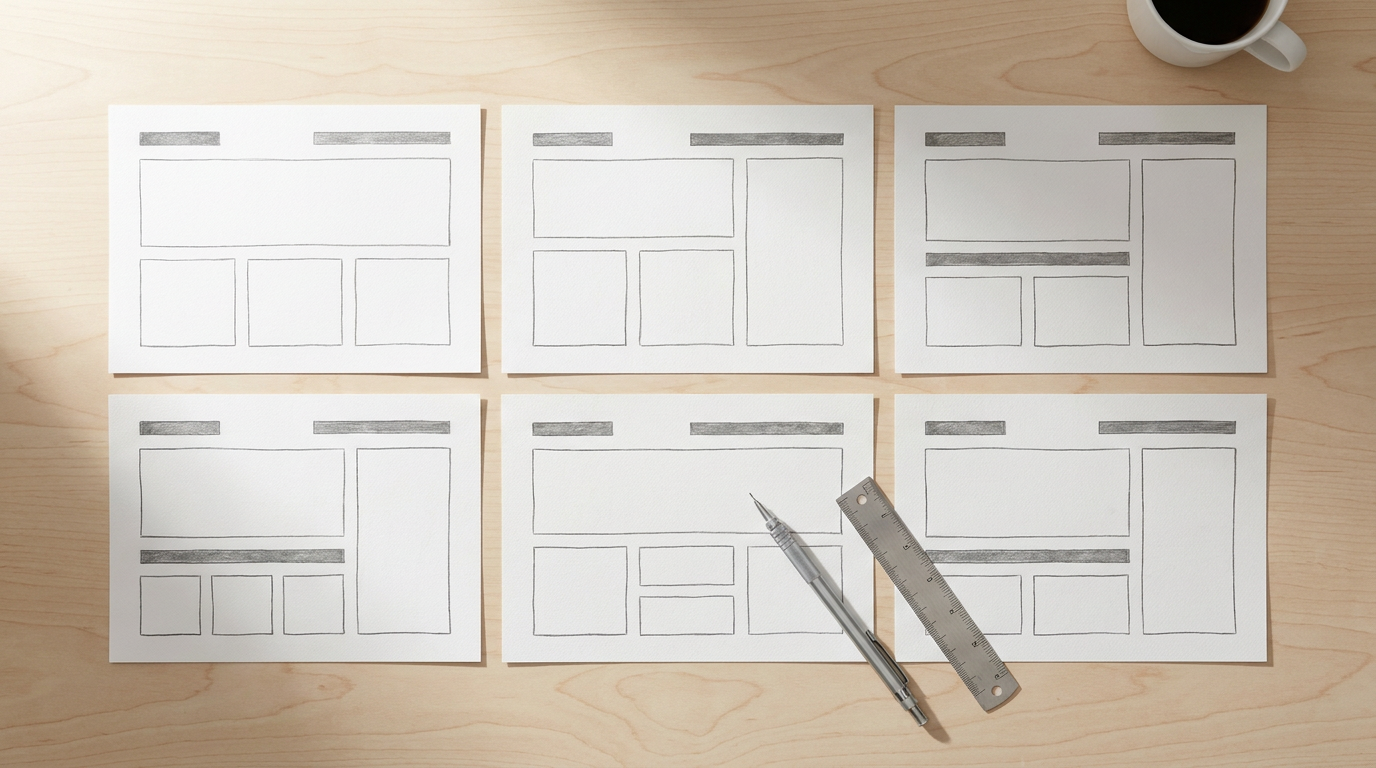
Count templates, list pages, and name every integration by product. A template is a unique layout that gets designed once and reused. A page is an instance of a template with different content. Most small business sites need four to seven templates and anywhere from eight to forty pages.
A worked example
A Calgary trades company wants a site with a home page, an about page, six service pages, three service area pages, a blog index, a blog post layout, a contact page and a thank you page. That reads as fourteen pages, which sounds large. In template terms it is six: home, about, service, service area, blog index, blog post, plus two simple utility layouts. Written the second way, an agency can price the design work in an afternoon and the number drops, because the repeated pages are content entry rather than design.
Name the integrations, do not describe them
“We need online booking” is not scope. “We need Calendly embedded on the contact page” is scope, and it is roughly an hour of work. “We need a booking system that checks technician availability, takes a deposit through Stripe and pushes the job into Jobber” is also scope, and it is a different project entirely. Name the actual products: the CRM, the payment processor, the email platform, the booking tool, the inventory system. If you have not chosen yet, say so and ask the agency to recommend one, which is a separate and much smaller line item.

Say what is out of scope
Exclusions are worth as much as inclusions. A single line such as “no ecommerce, no member logins, no multilingual version in phase one” removes an entire category of contingency pricing. Phase one is a useful phrase in a brief. It tells the agency you understand sequencing and are not going to ask for everything at once.
Be explicit about what happens to the old site
Migration is quietly one of the most expensive line items on a rebuild. Two hundred old blog posts moving across with their URLs intact, redirects mapped and images re-uploaded is days of work, not hours. If your existing site has traffic worth protecting, say so in the brief and ask the agency how they handle redirect mapping. Our guide to a website redesign without losing SEO traffic covers what that process should look like, and the answer you get back is a fast way to gauge whether an agency actually does technical work or just design.
Should You Put a Budget in the Brief?
Yes, as a range. Withholding your budget does not protect you from being overcharged, it just guarantees you receive proposals aimed at the wrong tier. Agencies scope to budget the same way a builder scopes a renovation to budget. Given a number, a good one tells you what is achievable within it and what is not.
The fear is that naming a number means paying that number. In practice the opposite tends to happen. A blind quote carries a risk premium, because the agency is pricing for the possibility that you want something far more complex than you do.
Canadian budget bands, roughly
These are published market ranges for Canadian agencies and freelancers in 2026, not measured averages. Verify against actual quotes in your city, since rates in Toronto and Vancouver sit above Calgary and Edmonton, and rural rates sit below all of them.
| Band (CAD) | What it typically buys | Honest limitation |
|---|---|---|
| Under $2,500 | Freelancer, premium theme, light customisation, you supply all content | Little strategy, no SEO structure, you own the maintenance |
| $2,500 to $8,000 | Small studio, custom layouts on a proven framework, basic copy support, forms and analytics configured | Usually excludes photography and complex integrations |
| $8,000 to $25,000 | Agency build, custom design system, copywriting, technical SEO baseline, one or two integrations, migration handled | Requires you to be available for reviews and decisions |
| $25,000+ | Multi template platform work, ecommerce or member systems, ongoing optimisation built in | Overkill for a straightforward service business |
If you want the reasoning behind these tiers in more detail, our Canadian digital agency pricing guide breaks down what changes as the number moves, and our website packages show how a fixed scope build is structured in practice.
One phrasing that works well in a brief: “Our range is $8,000 to $12,000. If you believe the outcome we described needs more than that, tell us what to cut or what to add.” That single sentence invites an honest conversation instead of a negotiation.

Who Is Actually Writing the Content?
Answer this in the brief or it will answer itself, badly, in week six. Content is the most common reason a website that was quoted at six weeks ships in five months. The design gets approved, development finishes, and then everything stops while somebody at the client tries to write twelve service pages between meetings.
There are only three honest options. Pick one per content type.
- Client supplies. Cheapest, slowest. Only works if a specific named person has time blocked for it and a deadline that precedes the build.
- Agency writes. Adds cost, removes the bottleneck. Expect an interview process and one to two revision rounds per page.
- Hybrid. Client supplies raw material and subject expertise, agency shapes and edits. This is the model most builds should use and the one most briefs forget to specify.
Photography deserves its own line
Stock photography is the fastest way to make a premium brand look like a template. If real photography matters to you, put it in the brief with a date. A half day shoot booked in week one arrives in time. A shoot discussed in week seven delays launch by a month, because the good photographers in most Canadian cities book three to four weeks out.
The content deadline goes before the design deadline
Write it in the brief as a date, not a phase. “All service page copy delivered by 15 September” is a commitment. “Content during build phase” is a wish. Realistic end to end timelines are covered in our breakdown of how long it takes to build a website, and content readiness is the variable that moves those numbers most.
Common Mistakes That Blow Up a Website Quote
- Sending a competitor URL with no commentary. “Something like this” tells an agency nothing. Say which part you like: the layout, the tone, the photography, the navigation. Three references with one sentence each beats a mood board.
- Asking for a quote before deciding whether this is a redesign or a rebuild. Keeping the existing platform and restyling it is a fundamentally different job from starting over.
- Leaving out who signs off. A brief that does not name the final decision maker produces committee revisions, and committee revisions are the most expensive hours in the industry.
- Requesting SEO without defining it. Technical setup, on page structure, content production and link acquisition are four different budgets.
- Treating the brief as a legal document. It is an alignment document. The contract comes later and should be based on the agreed proposal, not the brief.
- Sending it to twelve agencies. Three is the right number. Twelve produces a spreadsheet, not a decision, and good agencies deprioritise a scattergun request.
The Copy and Paste Website Brief Template
Fill in the bracketed parts. Delete anything that does not apply. Keep it under three pages.
1. Business context
We are [company], a [industry] business in [city]. We sell [products or services] to [customer type]. We have been operating for [years] and currently do most of our sales through [channel].
2. Why we are doing this now
Our current site is [age] years old and the specific problems are [problem one, problem two]. The trigger for acting now is [rebrand, new service line, a launch date, losing leads to competitors].
3. Primary audience
The main visitor is [role or situation]. They arrive from [Google search, referral, Instagram, a physical sign]. Before contacting us they need to be convinced of [the one objection you have to beat].
4. Primary goal and how we will measure it
The single most important action is [book a call, request a quote, buy, subscribe, apply]. We currently get [number] of these per month and we consider the project successful at [number]. Secondary goals are [list], and they must not compete with the primary one.
5. Scope
Templates required: [list, for example home, service, service area, about, blog index, blog post, contact]. Total pages at launch: [number]. Explicitly out of scope for phase one: [ecommerce, logins, multilingual, app].
6. Functionality and integrations
We need [forms to email and CRM, online booking via named tool, payments via named processor, IDX feed, gated downloads, live chat]. Our existing stack is [CRM, email platform, accounting, scheduling]. We are open to recommendations on [anything not yet chosen].
7. Content and photography
Copy will be [supplied by us, written by you, hybrid]. The named person responsible on our side is [name]. Existing content to migrate: [number] blog posts and [number] case studies, or none. Photography: [we have a library, we need a shoot, we will use stock].
8. Design direction
Three sites we like and why: [URL, what specifically], [URL, what specifically], [URL, what specifically]. Brand assets we already have: [logo, colours, typography, style guide, none]. Things to avoid: [specific, for example stock imagery, sliders, heavy animation].
9. Budget and timeline
Our budget range is [CAD range]. Our target launch date is [date] and it is [hard because of a specific event, or flexible]. We can commit to [number] revision rounds and reviews within [number] business days.
10. Decision process
The decision maker is [name and role]. We are speaking to [number] agencies. We will decide by [date]. Please include in your proposal: your assumptions, your exclusions, what you need from us and when, and what happens after launch.

How Do You Compare the Quotes That Come Back?
Read the assumptions and exclusions before you read the price. A proposal that lists its assumptions is written by someone who has delivered projects. A proposal that is only a number and a timeline is a sales document.
Score each response against these six questions before comparing totals.
- Did they restate your goal in their own words, or repeat yours back? Restating means they thought about it.
- Did they challenge anything in the brief? The best proposals disagree with something. Silent agreement usually means nobody read it closely.
- Are exclusions written down? Hosting, maintenance, licences, stock imagery, copywriting, migration and training are the usual gaps.
- What are the ongoing costs after launch? Plugin licences, hosting and a maintenance plan are real and recurring. Our guide to website maintenance costs in Canada covers what is normal.
- Who owns what at the end? You should own the domain, the hosting account, the content and the design files. Get that in writing.
- What happens if you go over? A named change request process is a sign of maturity, not of distrust.
A slightly higher quote with a clear scope, named exclusions and a change process is almost always cheaper by the end than a low quote with none of those things.
Frequently Asked Questions
How long should a website brief be?
One to three pages. Anything longer is usually a specification document, which is a different thing and appropriate for platform builds rather than marketing sites. If your brief is running past five pages, the project is probably large enough to warrant a paid discovery phase instead.
Do I need a website brief if I am hiring a freelancer instead of an agency?
More so, not less. A freelancer has no account manager to absorb ambiguity, so unclear scope turns into unpaid work, resentment and a stalled project. The same ten sections apply. You can shorten the design direction section if you have already seen and liked their portfolio.
What is the difference between a website brief and an RFP?
A brief describes what you want built and invites a conversation. An RFP is a formal procurement document with scoring criteria, compliance requirements and a fixed submission process, usually used by government and large institutions. For a private business under about $50,000, a brief is the right instrument. RFPs add weeks and tend to filter out the smaller specialist studios you probably want.
Should I include my current website analytics in the brief?
Yes, if you have them. Monthly sessions, top five landing pages, current conversion count and your main traffic source are enough. That data changes recommendations. A site with meaningful organic traffic needs a careful migration plan, while a site with almost none can be rebuilt more freely.
Is it rude to tell agencies who else I am talking to?
No, and you do not need to name them. Saying “we are speaking to three agencies and deciding by the 30th” is useful information that gets your project properly prioritised. Naming competitors is unnecessary and occasionally invites bad behaviour.
The Bottom Line
A website brief is ninety minutes of work that determines whether you get comparable quotes or a spreadsheet of guesses. Count templates rather than pages, assign content ownership to a named person with a date, name your budget range honestly, and write down what is out of scope. Everything expensive about a web project traces back to a decision that was left implicit.
If you would rather work through it with someone who builds these every week, our website packages and design packages are structured around exactly the scope questions above. Send us your brief, or your rough notes, through the Wise Media intake form and you will get back a scoped response with the assumptions written down.